


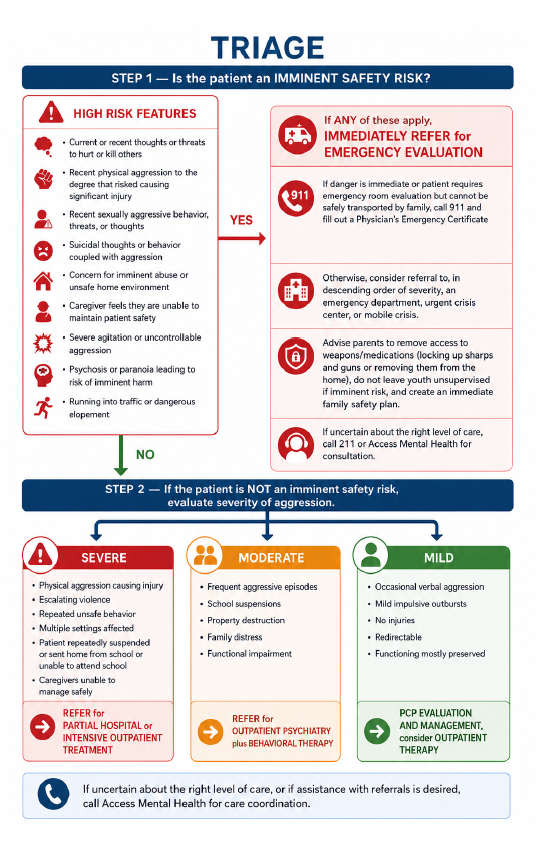
Childhood aggression is different from the typical frustration, irritability, and occasional outbursts that occur as part of normal development. Anger is a universal human emotion and, in isolation, is a symptom which does not always signify a disorder. Physical aggression is more common in early childhood and tends to diminish through adolescence. When aggressive behaviors become frequent, intense, or disproportionate, and interfere with relationships, safety, school functioning, or family life, they may indicate a more significant clinical concern.
Youth who have a history of trauma or adverse childhood experiences, exposure to violence, neurodevelopmental disorders such as ADHD, autism, undiagnosed learning disability or underlying mood or anxiety disorders are at heightened risk for developing problematic aggression. Environmental factors, including inconsistent caregiving, family stress, and excessive or dysregulated screen media use, may also contribute. Aggression is a common reason for pediatric mental health consultation and can present across a wide spectrum of severity, from verbal outbursts to significant safety risk.
Aggression can lead to serious impairment, including school suspensions or expulsion, peer rejection, family conflict, and involvement with juvenile justice systems. Persistent or escalating aggression can lead to injury, substance misuse, academic failure, and worsening mental health over time. Severe agitation may be associated with suicidal thoughts, impulsivity, or other high-risk behaviors, necessitating urgent evaluation.
Early identification is essential. Treatment focuses on identifying the underlying cause and typically includes behavioral strategies, parent management training, school-based supports, and outpatient therapy. More severe cases may require psychiatric evaluation and medication. Pediatricians play an important role in assessing risk, initiating treatment, coordinating care, and determining when a higher level of care is needed. With a structured approach and support from Access Mental Health psychiatric consultation, clinicians can help reduce harm and improve outcomes for youth with aggressive behaviors.
Reactive/Affective (Hot) – angry, explosive behaviors in context of a trigger, e.g., seen in ADHD, ASD, Depression, Bipolar d/o, anxiety etc.
Proactive/Instrumental (Cold) – Premeditated, controlled, goal directed, e.g., seen in conduct disorder, antisocial personality disorder.
During the visit:
| Domain | Key Elements to Assess |
| Patient – Behavior | Type (verbal/physical), frequency, severity, triggers, consequences, functional impact, targets, risk assessment |
| Patient – Developmental/Social | Temperament, attachment, milestones/delays, trauma/abuse, bullying, exposure to violence, past concerning behaviors, substance abuse |
| Patient – Psychiatric | Underlying psychiatric disorders, cognitive abilities/IQ, learning issues, school functioning, peer relationships |
| Patient – Medical | Neurological conditions, TBI, sleep issues, medications (OTC/prescription) |
| Family | Family psychiatric history, caregiver mental health, parenting style, discipline consistency |
| Environment | Settings of aggression (home/school/online), recent stressors, trauma exposure, unsafe neighborhood/community violence |
| Appearance: Assess for attitude/demeanor (eye contact, handshake, hostility, withdrawn), behavior, cooperativeness, movement (hyperactivity, pacing) |
| Speech: Volume, rate, (fast or slow), tone (frustration, anger) |
| Thoughts: Ask about hallucinations, thoughts of suicide or homicide |
| Cognition: Orientation to person, place, time |
Children with ADHD are more often aggressive due to impulsivity, emotional dysregulation, and poor frustration tolerance. They may react quickly when upset, have difficulty managing strong emotions, and struggle to consider consequences before acting. Aggressive behaviors are frequently seen during transitions, periods of frustration, or during interpersonal conflicts. This type of aggression often improves if ADHD symptoms are well treated with medication. When evaluating aggression, assess for symptoms of inattention, hyperactivity, and impulsivity.
Substance use can present with new or worsening aggression. Intoxication, withdrawal, and substance-related lifestyle changes can contribute to irritability, poor judgment, and behavioral dysregulation. Warning signs may include changes in peer groups, declining academic performance, mood changes, secrecy, or legal problems.
Bipolar disorder can present with significant irritability and aggression, particularly during manic or mixed episodes. Aggression may occur in the setting of decreased need for sleep, elevated or irritable mood, increased energy, impulsivity, grandiosity, and/or racing thoughts. A key distinguishing feature is the episodic nature of symptoms. Youth with bipolar disorder may also experience episodes of depression.
DMDD is characterized by chronic irritability, dysphoria, and severe temper outbursts that are out of proportion to the situation and developmental level of the child. Outbursts occur frequently and are accompanied by a persistently negative mood between episodes. Unlike bipolar disorder, symptoms are chronic rather than episodic. Children with DMDD frequently present with significant aggression during emotional outbursts which leads to impairment at home, school, and/or social settings.
Depression in children and adolescents often presents as increased irritability. Youth experiencing depression may have a lower frustration tolerance and be prone to verbal or physical outbursts. Other symptoms may include changes in sleep, appetite, energy, concentration, academic performance, or interest in previously enjoyable activities. Screening for depression should be considered when aggression is accompanied by mood changes or social withdrawal.
Children with autism spectrum disorder may become aggressive when overwhelmed, unable to communicate their needs, experiencing sensory distress, or coping with changes in routine. Aggression is often reactive rather than premeditated and is typically preceded by escalating signs of distress. Similar outbursts can occur in children with intellectual disability, language disorders, learning disorders or other neurodevelopmental conditions. A developmental history and assessment of communication skills, adaptive functioning, and sensory sensitivities can be helpful in clarifying the underlying cause of aggressive behavior. It may also be helpful to attempt to discern a common trigger for these behaviors, such as a certain school subject.
Children with ODD demonstrate a persistent pattern of irritability, defiance, and conflict with authority figures. Aggressive behavior may occur during arguments or when limits are set, although physical aggression is not required for the diagnosis. ODD commonly co-occurs with ADHD, and sometimes with anxiety or mood disorders, making a thorough assessment of underlying contributors particularly important.
Conduct disorder should be considered when aggression is severe, premediated, or associated with significant violations of the rights of others. Behaviors may include bullying, physical fights, cruelty to animals, property destruction, theft, or serious rule violations. These youth often require a more comprehensive assessment and more intensive treatment due to the increased risk of legal, academic, and social difficulties.
Anxiety can sometimes present as irritability and aggression, particularly in younger children. Aggressive behavior typically occurs when an anxious child is overwhelmed, confronted with a greatly-feared situation, or struggling to communicate distress. Aggression typically occurs in conjunction with avoidance behavior. Symptoms such as excessive worry, reassurance-seeking, somatic complaints, separation difficulties, or social fears also suggest an underlying anxiety disorder.
Psychotic disorders are uncommon in children and adolescents but should be considered when aggression occurs in the context of hallucinations, delusional beliefs, paranoia, or significant thought disorganization. Sometimes aggression may occur as a consequence of command hallucinations to harm others. New-onset psychotic symptoms warrant prompt psychiatric evaluation.
Medical causes should be considered when aggression develops suddenly, is accompanied by unprecedented cognitive or neurologic changes, or represents a marked departure from baseline functioning. Potential contributors include sleep disorders, seizure disorders, traumatic brain injury, thyroid dysfunction, medication effects, chronic pain, and other medical conditions. A thorough medical history and review of systems can help identify contributors to behavioral change.
Treatment of pediatric aggression involves a stepwise approach of ensuring safety, addressing underlying causes, then implementing psychosocial interventions and combining with medication when necessary. Evidence strongly supports parent-focused and multicomponent behavioral programs as first-line treatments, with pharmacologic options reserved for severe, refractory, or cases with comorbid psychiatric conditions.
Guidelines for Treatment
| Category | Intervention/Medication | Description/Dosing/Notes |
| Behavioral Therapy | First-line treatment for aggressive and disruptive behaviors | |
| Parent Management Training (PMT) | -Teaches caregivers consistent discipline techniques and reinforcement strategies Resources: Parent Management Training (PMT) – Child and Family Institute Parent Resources – PMTI | |
| Multicomponent Interventions | -Combine parent, child and teacher involvement -Shown to reduce disruptive behaviors in preschool and school-aged children | |
| Cognitive Behavioral Therapy (CBT) | -Helps children develop emotion regulation and coping skills | |
| Applied Behavioral Analysis (ABA) | -Especially beneficial for children with Autism Spectrum Disorder (ASD) | |
| Social Skills Training | -Improves social interaction and conflict resolution skills | |
| Key Behavioral Strategies | -Positive reinforcement -Clear expectations and routines -Consistent (non-punitive) consequences -De-escalation techniques | |
| School-Based Interventions | Educational and behavioral supports within the school setting | |
| Individualized Education Plan (IEP) | -Provides individualized academic and behavioral supports | |
| Behavior Intervention Plan (BIP) | -Structured plan addressing specific behavioral concerns | |
| Classroom Accommodations | -Environmental and instructional modifications to support behavior and learning | |
| Family Interventions | Family-focused approaches to improve home functioning | |
| Family Therapy | -Improves communication patterns and problem-solving skills | |
| Parenting Support | -Addresses parenting-style inconsistencies and reinforces behavioral strategies | |
| Conflict Reduction | -Reduces exposure to family conflict and stressors |
| Category | Intervention/Medication | Description/Dosing/Notes |
| General Principle | Not first-line treatment unless aggression is severe, dangerous, or linked to a specific disorder | |
| ADHD-Related Aggression | Stimulants (First-line) |
|
| Severe Aggression (Especially ASD or ODD/CD) | Risperidone |
|
| Aripiprazole |
|
|
| Mood-Related Aggression | SSRIs |
|
| Mood Stabilizers |
|
|
| Impulse Control/Hyperarousal | Guanfacine IR |
|
| Clonidine IR |
|
|
| Intermittent Mild Aggressive Episodes | Hydroxyzine (PRN) |
|
American Academy of Pediatrics
ACCESS Mental Health for Youth Clinical Conversation Trainings on ADHD and ASD:
ADHD
Provider Toolkit: Attention Deficit Hyperactivity Disorder (ADHD)
A guide specifically designed for pediatric and family care physicians (PCPs) and provides actionable information, algorithms, and insights so that providers and practices can successfully address pediatric mental health and substance use conditions within their practice.
ASD
** Special thanks to Dr. Paul Weigle, Dr. Saachi Tarr, Dr. Natalie March, Dr. Jensi George and
Dr. Sudeshna Basu for their contributions